
Rights and Obligations of Parties in a Construction Law Contract

Society of Construction Law Bangladesh (SCLB)
Date: 30th July 2025
Introduction
Construction contracts serve as the foundational legal instruments underpinning all construction-related activities. These agreements delineate the rights, responsibilities, and expectations of the parties involved, fostering transparency and minimizing the risk of disputes. Each construction project is typically composed of multiple stakeholders such as principals (employers), contractors, subcontractors, architects, engineers, financiers, and suppliers, each playing a distinct and critical role. A clear understanding of the respective roles and legal obligations of these entities is essential for the effective execution of any construction endeavour.
Parties to a Construction Contract
At its core, a construction contract is a legally binding agreement characterized by an offer, acceptance, consideration, and the intention to create legal relations. Such contracts form the structural backbone of construction projects, ensuring that all parties are bound by specific performance and compliance obligations.
The Employer and the Contractor
The primary contractual relationship in most construction projects is between the employer (also referred to as the principal) and the contractor. The employer engages the contractor to execute specified works, often with the intention of constructing, renovating, or developing a property or infrastructure.
In addition to the principal parties, various ancillary participants play integral roles:
- Subcontractors, engaged by the main contractor, are responsible for specific components of the work and operate under the terms of a subcontract.
- Financiers, typically banks or lending institutions, provide necessary capital, often secured through instruments such as mortgages or guarantees.
- Designers, either nominated by the employer or contractor, are tasked with formulating the design specifications and technical drawings that govern the scope and quality of the construction works.
Disputes arising from the interpretation of contractual terms or issues related to performance may be addressed through arbitration or adjudication, both of which offer structured mechanisms for dispute resolution outside the traditional court system.
Rights and Obligations of the Employer
The employer’s legal entitlements are primarily designed to ensure that their interests are protected throughout the course of the project. These include:
- The right to advance payment securities and performance guarantees from the contractor.
- Entitlement to indemnities, liquidated damages, and other remedies in the event of breach, delay, or non-performance by the contractor.
- The right to approve subcontractors, receive project updates, and exercise intellectual property rights over project-related documentation and designs.
Conversely, the employer is obligated to:
- Make timely payments as per the agreed terms.
- Provide site access and requisite permits and approvals.
- Facilitate logistics, such as equipment delivery, and furnish necessary documents and drawings to support execution of the works.
Contractors and Subcontractors: Legal Standing and Duties
Contractors are vested with the right to access the site, mobilize labour, install materials, and execute works according to the contract. Upon satisfactory performance, they are entitled to payment. They may also propose variations to the scope of work, subject to the employer’s consent.
Their key obligations include:
- Adhering to technical specifications and quality standards.
- Cleaning and demobilizing the site post-completion.
- Rectifying defects within the designated defects liability period.
Subcontractors, while not in privity with the employer, assume duties under their subcontract and are accountable to the main contractor. They are entitled to payment for services rendered and may resist demands that fall outside the scope of their agreement. Their responsibilities mirror those of the contractor but are limited to the specific tasks allocated to them.
Role of Financiers and Designers
Financiers are crucial in ensuring the financial solvency of a construction project. They may provide:
- Syndicated or bilateral loans.
- Self-financing mechanisms through private equity or corporate funding.
Where financing is provided through debt instruments, financiers typically require project monitoring rights, progress reporting, and security interests (e.g., lien or assignment of rights) to safeguard their investment.
Designers, whether architects or engineers, vary in their involvement depending on the project model:
- In traditional models, the employer separately appoints the designer, who is liable for design errors.
- In design-build contracts, the contractor assumes responsibility for both the design and execution, thereby accepting liability for any defects arising in either phase.
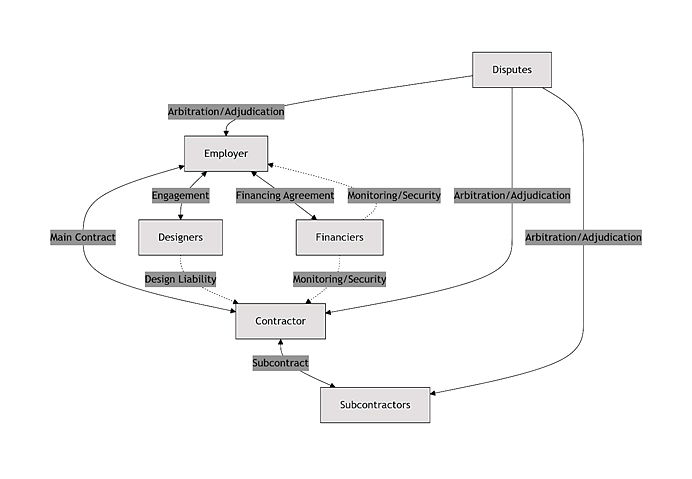
Diagram: Parties to a Construction Law Contract
Legal Character of Construction Relationships
The contractor-employer relationship is one of principal-to-principal, whereas subcontractors function as agents under the contractor’s responsibility. Importantly, subcontractors do not possess direct legal standing to enforce claims against the employer unless a direct agreement or novation exists. Similarly, the financier’s role, though external to the construction contract, is often secured by tripartite agreements, step-in rights, and contract assignments.
Conclusion
The lantern of successful project execution is in the construction contracts, which set a clear guidance of role, rights and duties of the involved parties of the project namely, the employers, contractors, the subcontractors and financiers, and the designers. Such legally binding agreements offer transparency, minimize possible conflicts, and offer organized systems to solve conflicts, which leads to proper cooperation. Construction contracts also protect the interest of all parties involved by specifying the scope of the work, payment terms, contractual time limits and termination provisions, therefore, encouraging accountability and transparency during the project cycle of construction contracts. An effectively written contract with adherence to statutory provisions does not only help to reduce misunderstanding but also helps in increasing trust and cooperation within the stakeholders. Because the construction projects become more and more complicated, the significant role of advanced contracts and the observance of the legal standards cannot be underrated, because they remain the basis of ensuring the success of the project, environmental impact, and equity of the dispute resolution in the sphere of an industry-related to the creation of constructions.
Disclaimer:
The articles published on The Society of Construction Law Bangladesh (SCLBD) website are intended for research and educational purposes only. They are written in good faith to promote knowledge and understanding of construction law. No part of these articles may be reproduced, distributed, or used for any commercial purpose without prior written permission from SCLBD. While every effort has been made to ensure the accuracy of the information, Readers are advised to consult legal professionals for advice on particular matters.